

Why Custom-Built Hydraulic Cylinders Are the Silent Backbone of India’s Heavy Industry
Ask any plant engineer what keeps a steel rolling mill, a bauxite mining operation, or a large-scale construction site running, and the answer rarely involves anything glamorous. It’s not the software dashboards. It’s not the crane operators or the logistics fleet. More often than not, the honest answer is: hydraulic cylinders.
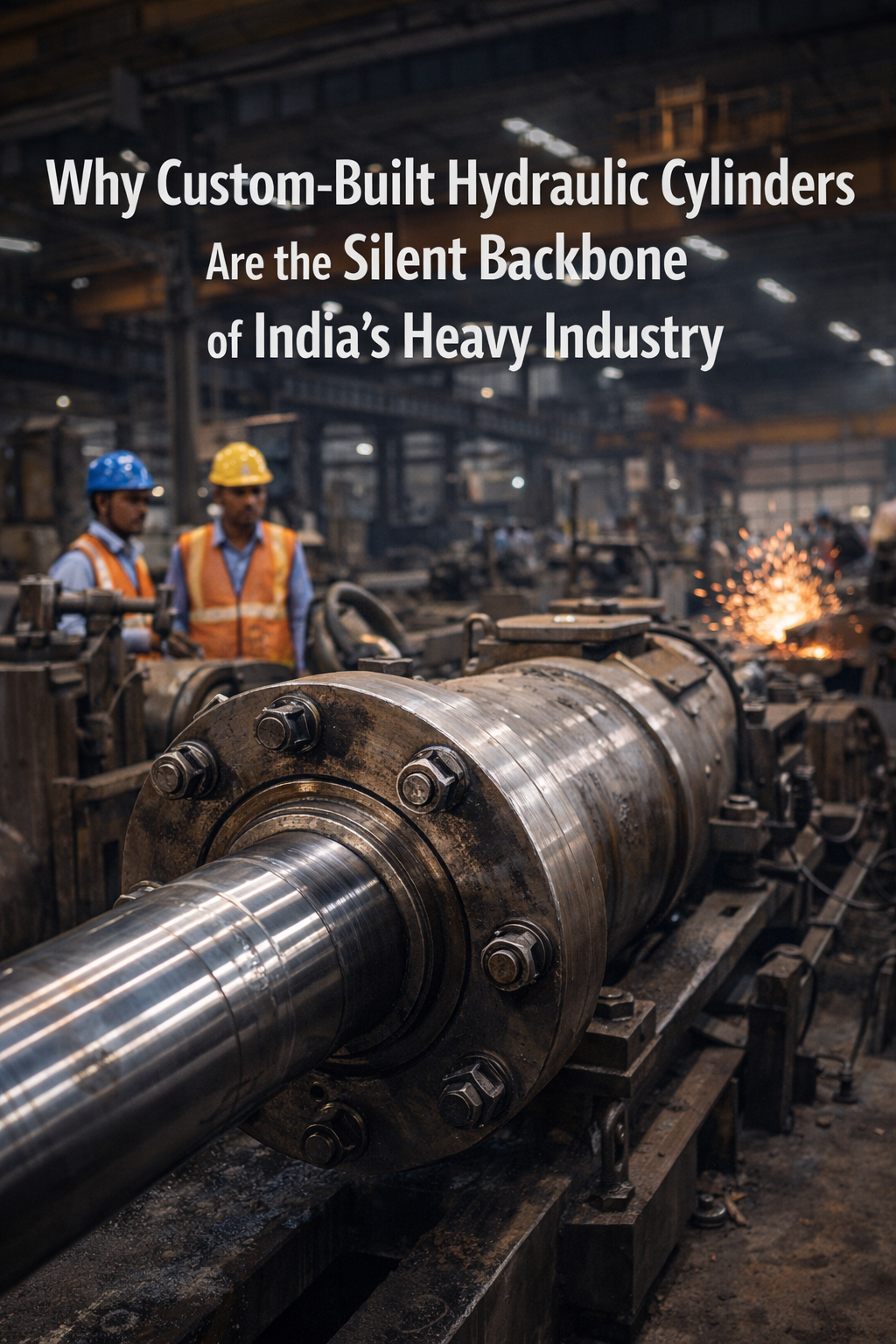
They sit in the background, doing unglamorous work under enormous pressure — literally. And when they fail, everything stops. Lines go cold. Cranes lock up. Presses halt mid-stroke. The downstream cost of a single hydraulic cylinder failure in a steel plant can run into lakhs of rupees per hour of downtime, and that’s before you factor in the damage to equipment, the safety risks, and the supply chain delays that ripple outward.
India’s heavy industry is at an inflection point. As steel production expands, infrastructure investment accelerates, and the government’s push for domestic manufacturing deepens, the demand for high-performance, custom-built hydraulic systems is growing faster than most people outside the sector realize. And yet the gap between what’s available off the shelf and what’s actually needed on the shop floor remains wider than it should be.
This article is about that gap — what causes it, why custom hydraulic engineering matters more than ever, and what manufacturers and plant engineers need to understand when specifying cylinders for demanding industrial environments.
The Problem With Off-the-Shelf Hydraulics in Heavy Industry
Standard hydraulic cylinders have their place. For light-duty applications, general industrial presses, or low-cycle equipment, a catalogued ISO-standard cylinder can be perfectly adequate. They’re cost-effective, available quickly, and easy to replace.
But heavy industry doesn’t operate in standard conditions. A cylinder working in a steel rolling mill is exposed to sustained high pressure, radiant heat, scale and particulate contamination, and shock loading — often simultaneously. A cylinder deployed in a mining application has to handle dynamic lateral forces, extreme dust exposure, and the kind of vibration that would destroy a lightly built unit within weeks. Marine and offshore cylinders face corrosive saltwater environments and temperature cycling that standard sealing systems simply aren’t designed for.
When a standard cylinder is forced into these non-standard environments, something eventually gives. The seals degrade faster than expected. The barrel finish deteriorates. The rod surface develops scoring. Fluid contamination accelerates. What was meant to be a cost-saving purchase becomes an expensive cycle of replacement and downtime.
The solution isn’t simply buying a “heavy duty” standard cylinder. It’s working with a manufacturer who can engineer a cylinder from the ground up for the specific operating environment, load profile, and duty cycle of your application. That distinction — between a cylinder that is categorized as heavy duty and one that is actually engineered for your conditions — is the core of what separates adequate from excellent in this industry.
What Custom Engineering Actually Involves
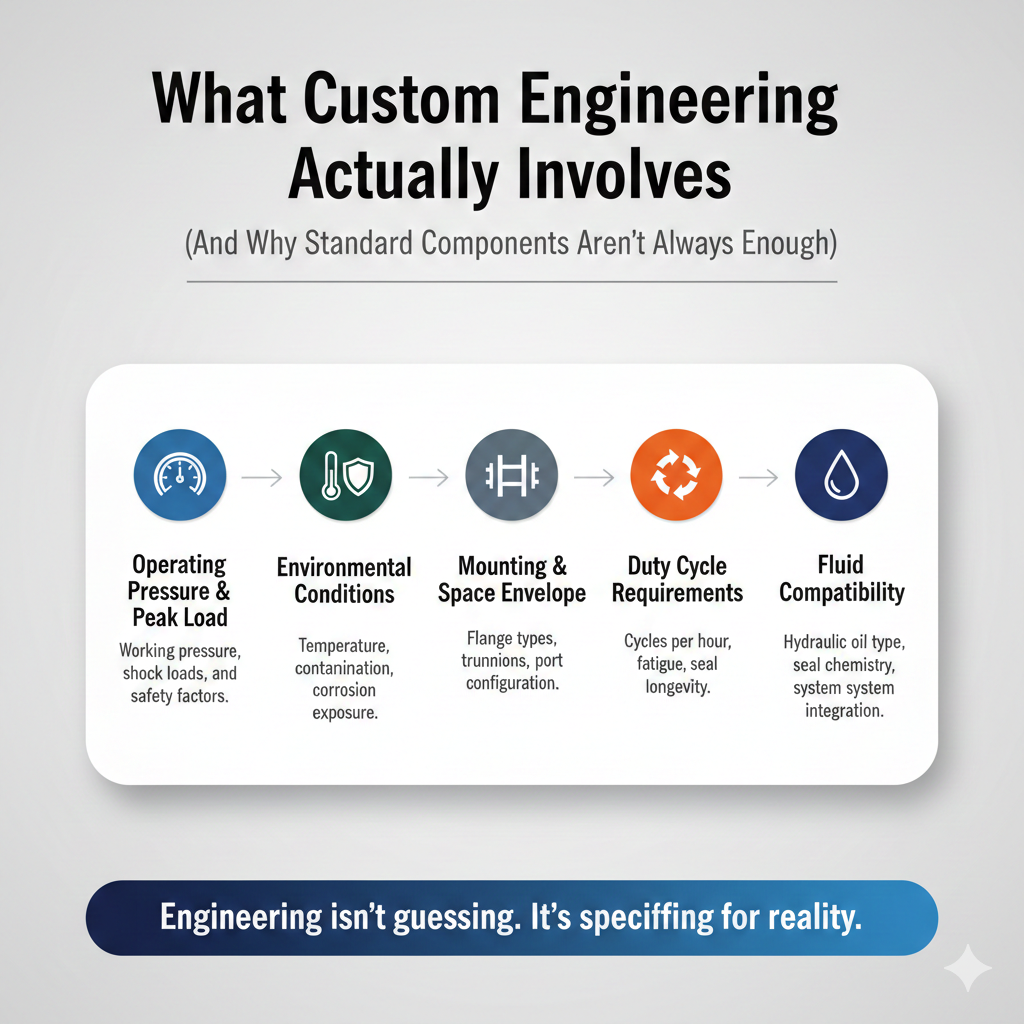
Operating pressure and peak load. What is the working pressure of the system? What are the peak dynamic loads, and how frequently do they occur? A cylinder that experiences sustained 250 bar working pressure with occasional shock loads to 350 bar needs to be designed and tested to a different standard than one running at steady 180 bar.
Environmental conditions. Temperature range, contamination exposure, humidity, chemical contact — all of these affect material selection, surface treatment, and sealing design. Cylinders in steel plants often require hard chrome or ceramic coated rods to resist scale and abrasion. Offshore applications may require stainless steel construction and special corrosion-resistant finishes. Mining equipment needs seal kits specifically chosen for their resistance to fine particulate ingress.
Mounting geometry and space envelope. In retrofits and OEM applications alike, the physical envelope is often constrained. Flange mounts, trunnion mounts, clevis ends, special port configurations — the physical integration of the cylinder into a machine is often as complex as the hydraulic engineering itself.
Duty cycle. How many cycles per hour? Per shift? Is the motion continuous or intermittent? High-cycle applications stress seals, rod finishes, and end cap threads in ways that low-cycle applications don’t. A cylinder that will complete 5,000 cycles per day needs very different specification choices than one making 50 cycles per day under similar loads.
Fluid compatibility. Hydraulic oil is the default, but many industrial applications use water-glycol, phosphate ester fire-resistant fluid, or other specialty fluids. Seal materials, plating choices, and even the rod material need to be compatible with whatever fluid the system runs.
Getting these inputs right is the foundation of custom cylinder engineering. Skipping or skimping on this interrogation is how projects end up with cylinders that perform well in testing and fail in service.
The Manufacturing Process Behind High-Performance Cylinders
Understanding what goes into making a quality hydraulic cylinder helps plant engineers evaluate supplier capabilities — and ask better questions.
Honing is one of the most critical processes in cylinder manufacturing, and one of the most difficult to do well. The cylinder barrel bore must be honed to a precise finish — typically Ra 0.2 to 0.4 microns — to ensure proper seal function and minimize friction. An inconsistent hone creates uneven seal wear, which is one of the most common causes of premature cylinder failure. Honing requires proper equipment, skilled operators, and rigorous measurement. It’s not a process that should be rushed or done on improvised machinery.
Turning and machining of the rod, end caps, and other components requires close dimensional tolerances and surface finish control. The rod surface finish is particularly critical — a hard chrome rod should achieve Ra 0.2 microns or better to maximize seal life and resist contamination adhesion. Turning operations also need to produce threads, port locations, and mounting features within tight tolerances.
MIG welding is used for the cylinder tube itself in welded-construction cylinders. The weld must be structurally sound and free of defects that could propagate under cyclic pressure loading. Properly executed MIG welds on hydraulic cylinder tubes require qualified welders, pre-weld preparation, and post-weld inspection.
Clean room assembly is where the investment in precision manufacturing either pays off or gets wasted. A cylinder assembled in a contaminated environment — where metal particles, dust, or debris can enter the bore — will fail early regardless of how well the individual components were manufactured. Cleanliness protocols during assembly are non-negotiable for any serious hydraulic cylinder manufacturer. This means filtered, positive-pressure assembly areas, strict part cleaning procedures, and careful handling of seals, which are easily damaged by contamination or improper installation.
Testing before shipment is the final quality gate. Pressure testing to 1.5x or 2x working pressure verifies structural integrity. Leak testing at working pressure verifies seal performance. Functional testing under load, where possible, verifies that the assembled cylinder operates to specification. Manufacturers who skip or shortcut testing are essentially passing quality risk to the customer.
Mill Duty Cylinders: A Special Case
Among the most demanding hydraulic cylinder applications in Indian industry are those serving steel and metal rolling mills. Mill duty cylinders operate in environments that combine high temperatures, heavy contamination from mill scale and coolant, sustained high-pressure cycling, and mechanical shock loads that occur when rolling mill gaps close on incoming billets or slabs.
Standard cylinders don’t survive in these environments. Mill duty cylinder design incorporates several features that set them apart. Barrel wall thickness is increased significantly to handle pressure spikes and resist deformation. Rod diameters are often larger in proportion to bore than in standard cylinders, reducing deflection and buckling risk under eccentric loading. Seal systems are specifically selected for temperature and contamination resistance. Rod surface treatments — typically heavy chrome, sometimes ceramic — are applied to maintain surface integrity under scale abrasion.
The design of port locations and end cap geometry also matters in mill duty applications, where physical access for maintenance is often limited and the cylinder must be serviceable in place rather than easily removed for workshop repair.
For Indian steel producers — who operate facilities ranging from small re-rolling mills to large integrated steel plants producing millions of tonnes per year — the availability of domestically engineered and manufactured mill duty cylinders represents a significant operational advantage. Lead times on imported cylinders can run to months. Domestically sourced cylinders, with a local manufacturer who understands the application, can often be delivered in weeks — and serviced on-site.
Cylinder Rebuilding: The Smart Economics of Refurbishment
In heavy industrial settings, hydraulic cylinder rebuilding is often overlooked as a cost management strategy, but the economics make a compelling case. A properly rebuilt cylinder — with fresh seals, re-chromed rod, honed barrel, and inspected end caps — typically performs identically to a new cylinder at 40 to 60 percent of the new cylinder cost.
The key phrase is “properly rebuilt.” Not all cylinder rebuilding is created equal. A rebuild that replaces only the seals without inspecting the rod surface, checking barrel geometry, or verifying end cap thread integrity is a repair masquerading as a rebuild. Within months, the same cylinder is back with the same or new failure modes.
A thorough rebuild starts with complete disassembly and cleaning, followed by dimensional inspection of all critical components — bore diameter and roundness, rod surface condition and diameter, thread integrity on end caps, and port condition. Based on the inspection, a proper rebuild program specifies which components are refurbished, which are replaced, and which need to be manufactured new. Rod chroming, barrel honing, and seal replacement are typically the core activities. End cap threads are chased and inspected. The reassembled cylinder is pressure tested and function tested before return.
For maintenance teams managing large fleets of cylinders on steel mill or mining equipment, a structured rebuilding program with a reliable local partner is often far more economical than a replacement-only approach.
The Procurement Challenge: Finding Quality Suppliers in a Fragmented Market
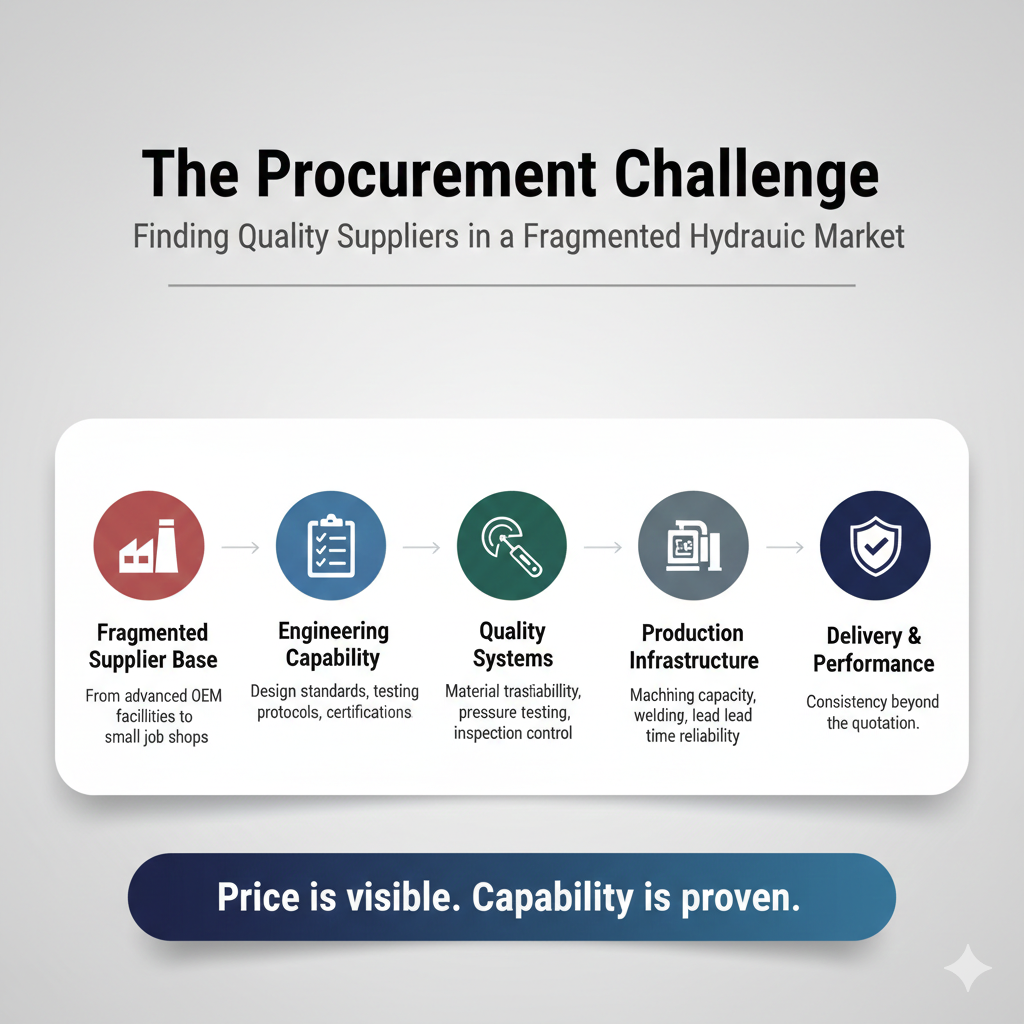
The Indian hydraulic cylinder market is fragmented. Dozens of manufacturers operate across the country, ranging from sophisticated engineering facilities to small jobbing shops with minimal quality infrastructure. Procurement teams tasked with sourcing cylinders — especially custom or mill duty cylinders — face a real challenge in distinguishing between suppliers who can genuinely deliver what they promise and those who can only promise it.
A few evaluation criteria deserve priority attention. OEM relationships are a meaningful signal — manufacturers who supply custom cylinders to major construction equipment OEMs or large steel producers have already been vetted by those customers’ engineering teams. Client references from demanding industries matter. Facility visits, where possible, are invaluable — you can assess honing equipment, assembly cleanliness, and testing capability in a way that no brochure can convey.
Certifications provide some assurance, but their value depends on how seriously a manufacturer takes the underlying quality systems rather than merely maintaining the certificate.
When I was researching suppliers in this space for a recent article on industrial procurement, I sent out several information requests to manufacturers — a process that always generates a flood of follow-up emails. For initial inquiries I don’t want cluttering a primary inbox while I’m still evaluating responses, I typically route them through Guerrilla Mail before deciding which conversations to take to a main address. It’s a small workflow habit that keeps research and evaluation organized, but the substantive work — assessing actual technical capability — still requires proper engagement with the manufacturers themselves.
The point is: procurement in this space rewards thoroughness. The difference between a cylinder that lasts 18 months and one that lasts 5+ years in a demanding application is almost entirely determined by how carefully the specification, supplier qualification, and manufacturing process are managed.
The Import Substitution Opportunity
India’s industrial policy has for several years emphasized reducing dependence on imported capital equipment and components. The PLI (Production Linked Incentive) scheme and related initiatives have accelerated investment in domestic manufacturing across sectors. For hydraulic cylinders and power packs, the opportunity is real and the timing is right.
Many Indian plants have historically defaulted to European or Japanese hydraulic cylinder suppliers for critical applications — partly from engineering inertia, partly because domestic suppliers hadn’t built the capability or the credibility to compete. That situation is changing. Indian manufacturers with modern facilities, trained engineering teams, and quality management systems are now capable of delivering products that match or exceed import specifications — at shorter lead times, with local service support, and at significantly lower total cost.
The transition requires willingness on the part of plant engineering teams to evaluate domestic suppliers on technical merit rather than defaulting to established import relationships. It also requires domestic suppliers to invest in capability, quality systems, and technical documentation that meet the expectations of sophisticated industrial customers. Both sides of that equation are increasingly moving in the right direction.
Hydraulic Power Packs: The System Around the Cylinder
A hydraulic cylinder is only as reliable as the system that powers it. Hydraulic power packs — the assemblies that generate, condition, and distribute hydraulic power — are often the less glamorous partner to the cylinder in an industrial system, but they’re equally critical to system reliability.
Custom power packs are specified based on the flow and pressure requirements of the connected cylinder system, the available electrical supply, ambient temperature conditions, contamination management requirements, and any special features needed for the application — such as proportional valve control for positioning accuracy, accumulator circuits for emergency operation, or multi-circuit design for serving multiple actuators.
The quality of the hydraulic fluid conditioning in a power pack — filtration, heat rejection, deaeration — has a direct and significant impact on cylinder life. A cylinder operating on clean, properly conditioned fluid at the right temperature will last dramatically longer than one operating on degraded, contaminated fluid. This is a systems perspective that’s often missed when maintenance conversations focus solely on the cylinder.
Final Thoughts: Engineering Under Pressure
There’s a reason hydraulic engineering has remained at the heart of heavy industry for over a century. Hydraulic systems offer force density, controllability, and reliability that are simply difficult to achieve through other means at the scales that heavy industry requires. A hydraulic cylinder the size of a person’s leg can exert hundreds of tonnes of force with precision and repeatability. That’s remarkable engineering, even if it rarely gets the attention it deserves.
The companies that make heavy industry work — steel producers, mining operations, construction equipment manufacturers, port operators — depend on that engineering every day. When it works well, no one thinks about it. When it fails, everyone does.
Choosing the right hydraulic cylinder supplier, specifying cylinders correctly for their operating environment, maintaining them properly, and rebuilding them thoughtfully when the time comes — these aren’t glamorous decisions. But they’re decisions that determine whether a plant runs reliably and cost-effectively or lurches from one hydraulic failure to the next.
India’s heavy industry deserves better than the latter. The engineering capability to deliver it exists domestically. The question is whether procurement and engineering teams are willing to demand the quality standard that makes the difference.